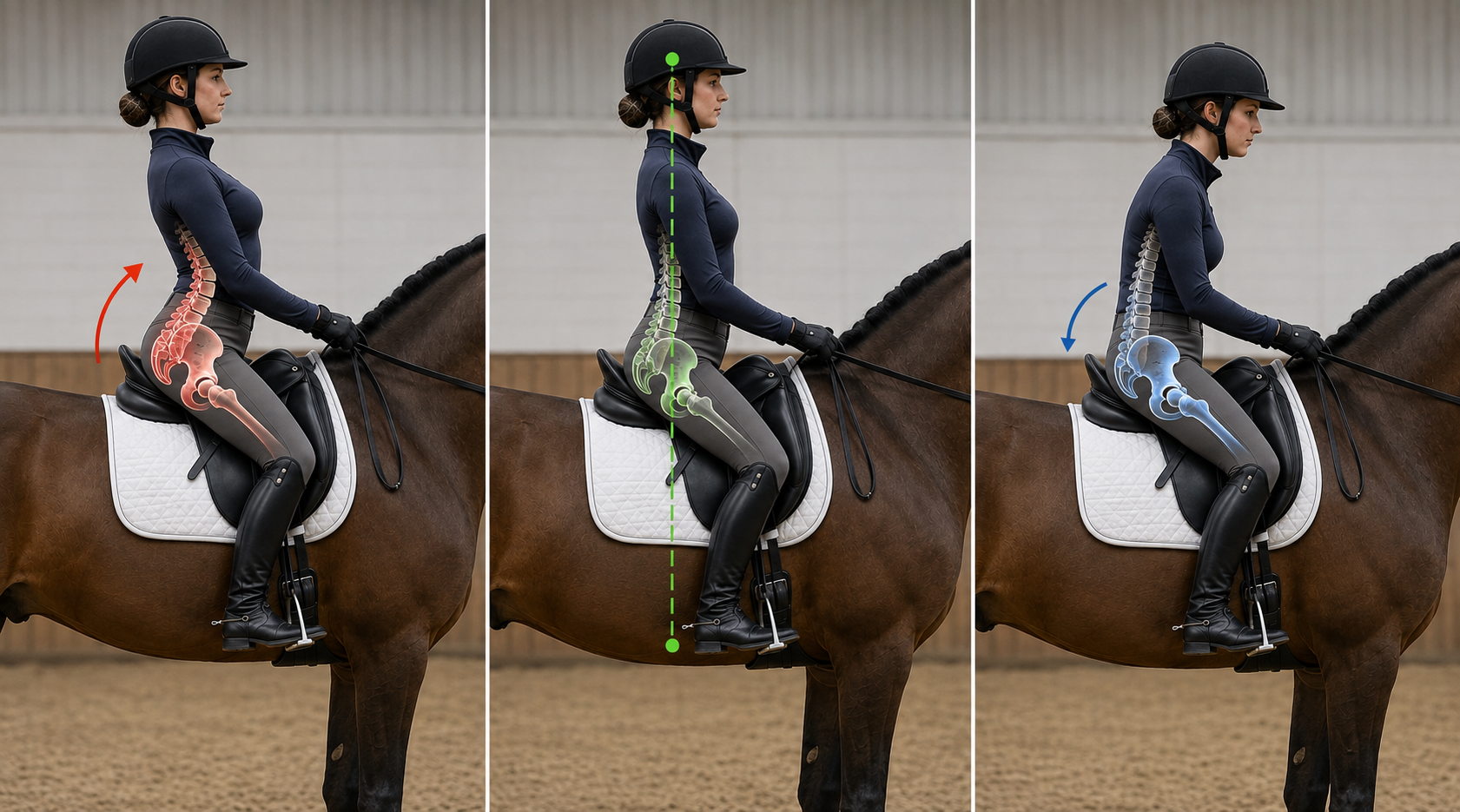
Bad posture is the most common reason for an Anterior or Posterior Pelvic Tilt.
For good posture, balance, and stability in the saddle, it is essential that we have a neutral pelvis. Having a neutral pelvis allows us to maintain upper body posture stability. Lower limb control WHILST allowing movement in the hips to follow the movement of the horse.
The tilt of the pelvis is determined by measuring the angle of the Anterior Superior Iliac Spine (ASIS) and the Posterior Superior Iliac Spine (PSIS). These are bony structures on the front and back of your pelvis. You should be able to feel these with your fingers.
There are many considerations when measuring the range of ASIS and PSIS. Generally, a neutral pelvis is when there is a straight line from the PSIS to the ASIS or a slight anterior (forward) angle of 7-10 degrees.
Anterior Pelvic Tilt (APT)
An Anterior Pelvic Tilt is when your pelvis is rotated forwards causing an increased curve in the lumbar (Lower Back) and an appearance of a ‘bulging’ stomach.
What muscles does APT affect?
When you have an APT the Rectus Abdominis and External Obliques (abdominal muscles) and Glutes & Hamstrings (bum & back of legs) are typically weak / lengthened muscles.
Simultaneously.
The Psoas, Iliacus (internal postural muscles), Rectus Femoris (quadriceps), Tensor Fascia Latae (Hip) and Erector Spinae (spine) muscles are strong and stiff.

How does an APT affect your riding?
You will have a tendency to sit on your pubic bone instead of your seat bones. And because you are sitting more forward you will further increase the already dominant arch in your lower back.
This reduces the suppleness of your shoulder girdle and hips. Which may result in being able to obtain an elastic contact (give and take with ease).

Due to the tight muscles in your quadriceps and TFL. You will also ride fairly short to counterbalance your seat and torso position.
This makes you feel perched and unstable at times. It is most noticeable through downward transitions.

A Posterior Pelvic Tilt (PPT)
A Posterior Pelvic Tilt is when your pelvis is rotated backward which causes the back to be pulled downwards giving the appearance of a [Flat Back and Flat Bum].
What muscles does PPT affect?
When you have a PPT you would have short & tight Hamstrings (back of legs), tight abdominal muscles (no, this is not a benefit as it will also be pulling on the pelvis, upwards which will make the PPT worse), and tight Glutes (bum), Weak Hip Flexors and lower back.
How does a PPT affect your riding?
You may find that you round your shoulders and carry your hands forwards and collapse through the chest and look downwards (think slumping in a chair).

Because of the slumping type of posture, the back is compromised and there is no ‘natural’ curve in the lower back which inhibits the spines’ ability to absorb shock. This can lead to pain over time and even compromise the structure of the spinal discs.

Does having a non-neutral Pelvic Tilt really matter?
It really depends on the extent of the tilt and whether you have any issues with riding and/or are suffering from some pain of some sort after riding.
More often than not, pelvic tilts occur over time from lack of exercise, mobility, and poor posture. Because it is often gradual, we don’t realize the effect it has on us.
The pelvis should have the mobility to move through the anterior, neutral, and posterior positions. When it is rigid it can cause a number of issues. From increased tension in the shoulders/neck to lower back ache/pain. You may even experience ‘Sciatic Symptoms’, due to the tight glutes applying pressure on the sciatic nerve. This can lead to pain and tingling sensations down one side. As well as a possible weakness in the knee and foot. This will, of course, affect your ability to control your legs.
Sciatica can only be determined by MRI, otherwise, it is a symptom. Which can typically be treated when the cause is addressed.
Understanding Your Pelvic Tilt Is Only the First Step
Identifying whether you have an anterior or posterior pelvic tilt can be helpful, but knowing what your posture is doesn’t automatically tell you how to improve it.
Many riders search online for a few stretches or strengthening exercises and hope that will solve the problem. Unfortunately, posture is rarely that simple.
Your pelvic position is influenced by the way your muscles support your body every day, not just when you’re riding. If those movement patterns have developed over months or years, correcting them usually requires more than stretching one muscle or strengthening another.
The key is following a structured programme that improves mobility where it is limited, restores strength where support is lacking and gradually teaches your body to maintain a more efficient posture without constantly thinking about it.
That’s exactly why we created the RiderCise® Postural Bundle.
Rather than providing a handful of isolated exercises, the programme includes progressive workouts designed specifically for riders with different postural patterns, including anterior pelvic tilt, posterior pelvic tilt and swayback posture. Each programme helps improve the support, mobility and control your body needs to create lasting changes that transfer into the saddle.
If you’ve recognised your own posture while reading this article, the Postural Bundle gives you the next logical step.